[Avg. reading time: 8 minutes]
Azure Cloud
Azure is a cloud computing platform provided by Microsoft that delivers computing resources over the internet on a pay-as-you-go model.
Core Concepts
Servers
Individual physical or virtual machines that provide compute power.
Data Centers
Physical facilities that host servers along with networking, storage, and other infrastructure components.
Availability Zones (AZs)
Each Availability Zone consists of one or more data centers within a region.
- Designed for high availability
- Provide fault isolation
- Connected through low-latency networking
Even if one data center fails, services in other zones continue to operate.
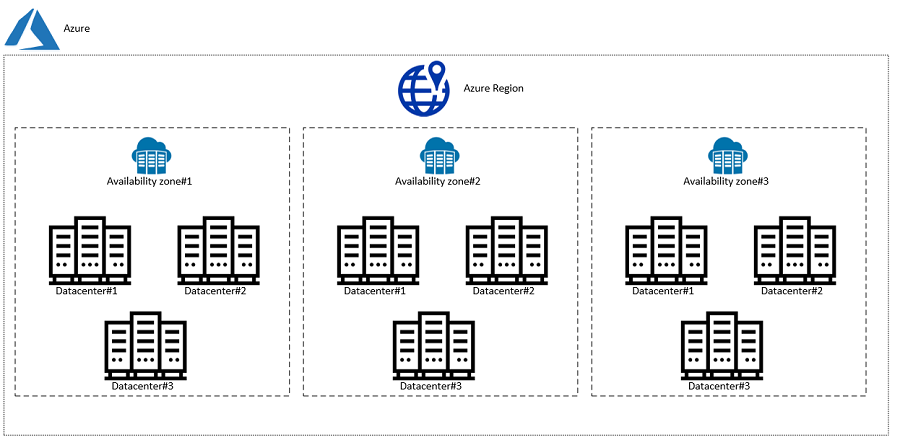
Source: https://www.unixarena.com/2020/08/what-is-the-availablity-zone-on-azure.html
Regions
Regions are geographically distinct locations that contain multiple Availability Zones.
- Help keep applications close to users
- Improve latency and performance
- Support data residency and compliance requirements
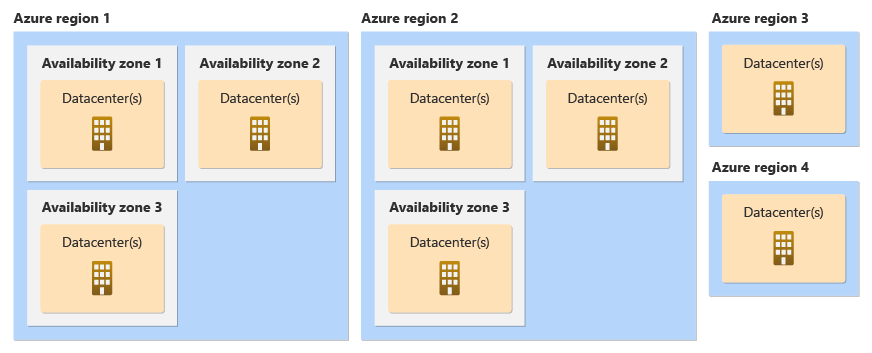
Source: https://learn.microsoft.com/en-us/azure/reliability/availability-zones-overview?tabs=azure-cli
Paired Regions
Azure regions are grouped into region pairs for disaster recovery.
- Located at least 300 miles apart
- Ensure isolation from large-scale failures
- Support cross-region replication
Geo-Redundant Storage (GRS)
- Data is stored in the primary region
- Automatically replicated to the paired secondary region
- Ensures durability and disaster recovery
Azure Site Recovery
Azure Site Recovery enables:
- Failover to a secondary region during outages
- Business continuity during disasters
- Automated recovery workflows
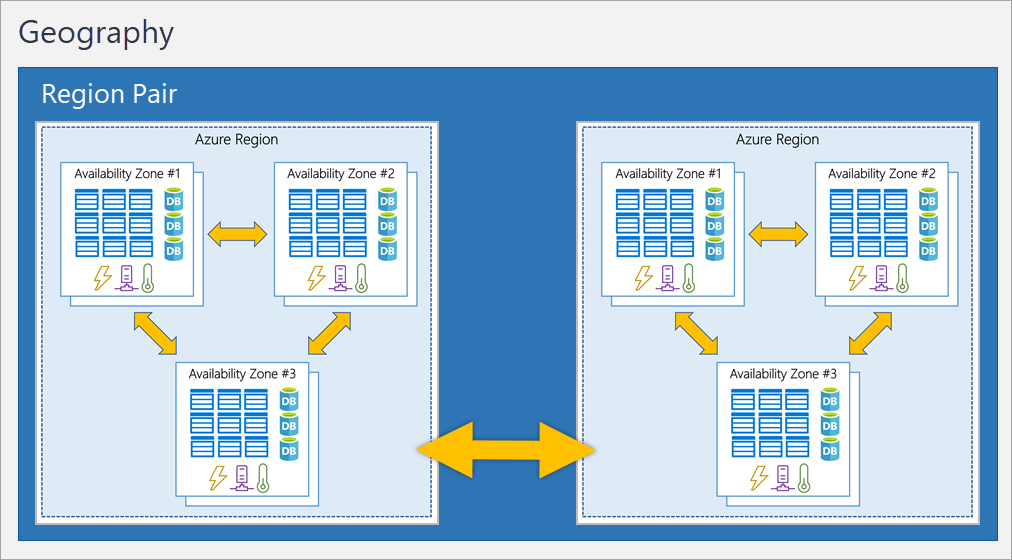
Source: https://i.stack.imgur.com/BwHct.png
How Everything Fits Together
- A Server runs your application
- Servers live inside a Data Center
- Multiple Data Centers form an Availability Zone
- Multiple Availability Zones form a Region
- Two Regions form a Paired Region
Real-World Example
Scenario: E-commerce Application
- Your application runs on servers in East US Region
- Deployed across 3 Availability Zones for high availability
- Database uses Geo-Redundant Storage (GRS)
- Backup region: West US (Paired Region)
What happens during failure?
- If one server fails : no impact
- If one data center fails : AZ handles it
- If entire region fails : failover to paired region
Minimal downtime, continuous service
Use Availability Zones when:
- You want high availability within a region
- Low latency is critical
Use Paired Regions when:
- You need disaster recovery
- You want protection from regional outages
Use Geo-Redundant Storage when:
- Data durability is more important than cost
Trade-offs
- Multi-zone deployments : Higher cost but better availability
- Multi-region deployments : Even higher cost + complexity
- GRS : More durable but increased storage cost and latency